SPC flooring has become a practical choice for Dubai homes and commercial interiors because it combines a realistic wood or stone appearance with a rigid, water-resistant core. However, choosing the right design is only one part of the decision. The installation method can significantly affect the floor’s stability, comfort, cost, and long-term performance.
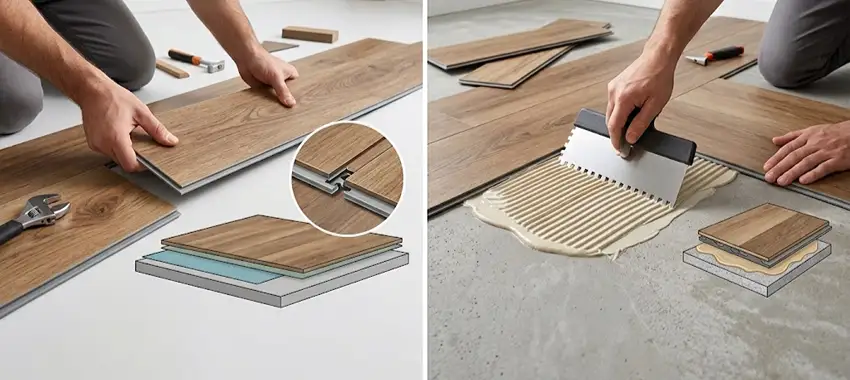
The two options commonly discussed are click-lock and glue-down installation. Click-lock SPC planks connect to each other and float above the subfloor, while glue-down flooring is bonded directly to the prepared surface with adhesive.
Although both systems can create an attractive and durable floor, they are suited to different environments. This guide compares click-lock and glue-down SPC flooring to help you select the right solution for your Dubai apartment, villa, office, shop, or hospitality project.
What Is SPC Flooring?
SPC stands for Stone Plastic Composite or Stone Polymer Composite. It is a rigid type of vinyl flooring constructed from multiple layers, including a protective wear layer, a decorative printed layer, and a dense composite core.
Quality SPC flooring in Dubai is valued for its dimensional stability, scratch resistance, simple maintenance, and ability to handle everyday moisture. It is commonly installed in living rooms, bedrooms, kitchens, corridors, offices, retail stores, and other busy indoor spaces.
SPC is part of the wider resilient flooring category. Customers comparing different constructions and installation methods can also explore vinyl flooring in Dubai before making a final selection.
An Important Note About “Glue-Down SPC”
Most rigid SPC planks are manufactured with a click-lock profile and are intended to be installed as floating floors. The term “glue-down SPC” may refer to:
- A rigid-core product specifically approved for adhesive installation
- A thinner rigid vinyl plank designed for direct bonding
- Glue-down LVT or dryback vinyl being marketed alongside SPC flooring
Never glue an SPC click-lock plank to the subfloor unless the product manufacturer specifically permits it. Using an unapproved installation method can restrict natural floor movement, damage the locking joints, and affect the product warranty.
For projects that specifically require direct bonding, LVT flooring may provide more purpose-built glue-down options.
What Is Click-Lock SPC Flooring?
Click-lock SPC flooring features precisely manufactured edges that connect one plank to another. The planks are fitted over the subfloor without being permanently bonded to it, which is why this installation is also called a floating-floor system.
Depending on the product, an acoustic underlay may be installed separately or already attached to the back of each plank. For example, products such as Classic Oak SPC Flooring use an interlocking floating-floor system with integrated underlay.
Advantages of Click-Lock SPC Flooring
Faster Installation
Click-lock planks do not require adhesive application or curing time. Once the subfloor is prepared, professional installers can connect the planks and complete many residential installations relatively quickly.
Cleaner Installation Process
Because there is no wet adhesive, click-lock installation generally produces less mess and fewer adhesive-related odours. The room can often return to normal use sooner, subject to the installation instructions.
Suitable for Renovations
A floating SPC floor can often be installed over existing tiles or another hard surface, provided the floor is dry, stable, level, and structurally suitable. This may reduce demolition work during apartment or villa renovations.
Easier to Remove
Click-lock planks are not permanently bonded to the subfloor. This makes the flooring more practical for rental properties, temporary commercial fit-outs, and interiors that may be renovated again in the future.
Better Acoustic Options
Many click-lock SPC products include a built-in acoustic backing. A suitable underlay can also help reduce impact noise and improve underfoot comfort, which can be useful in Dubai apartments.
Disadvantages of Click-Lock SPC Flooring
Requires a Flat Subfloor
The rigid construction does not hide bumps, dips, loose tiles, or uneven grout lines. Installing it over an unsuitable surface can cause movement, noise, joint damage, or visible unevenness.
Needs Expansion Space
A floating floor must be able to move slightly as indoor conditions change. Installers need to leave the expansion gaps specified by the manufacturer around walls, columns, door frames, and other fixed objects.
Can Sound Hollow
Poor subfloor preparation or an unsuitable underlay may create a hollow sound when people walk across the floor. Professional fitting and the correct backing material reduce this issue.
Floor Height May Increase
SPC planks and underlay can raise the finished floor level. Doors, skirting, transitions, kitchen units, and adjoining floor finishes may need adjustment.
What Is Glue-Down SPC Flooring?
In a glue-down installation, each approved plank or tile is fixed directly to the subfloor using a compatible flooring adhesive. There is no floating layer between the flooring and the prepared base.
Direct bonding creates a firm floor with minimal vertical movement. It is frequently considered for large commercial environments, high-traffic spaces, and projects where a lower floor profile is required.
However, the product, subfloor preparation materials, moisture-control system, and adhesive must all be compatible.
Advantages of Glue-Down Flooring
Firm Underfoot Feel
Because the planks are bonded to the subfloor, glue-down flooring generally feels solid and stable underfoot. It can also produce less of the hollow sound sometimes associated with floating floors.
Suitable for Large Areas
An approved glue-down system may be appropriate for large, open-plan commercial interiors where extensive floating-floor expansion requirements would be difficult to manage.
Better Resistance to Rolling Loads
Properly specified commercial glue-down flooring can be more suitable for environments with wheeled office chairs, trolleys, display units, or other rolling traffic. The exact performance depends on the product and adhesive specification.
Lower Installation Profile
Glue-down products are often thinner because they do not require a separate locking mechanism or thick underlay. This can simplify transitions between adjoining rooms and existing floor finishes.
Individual Plank Repairs
A damaged bonded plank may sometimes be removed and replaced without dismantling an entire row. The installer will still need to remove the adhesive residue and prepare the repair area correctly.
Disadvantages of Glue-Down Flooring
More Subfloor Preparation
The bonded floor follows the condition of the surface beneath it. Cracks, ridges, uneven patches, moisture problems, and visible grout lines must be treated before installation.
Longer Installation Process
Installers must prepare the floor, apply the correct amount of adhesive, position the planks carefully, roll the surface where required, and allow the adhesive to cure.
More Difficult to Remove
Removing bonded flooring can be labour-intensive. Adhesive residue may need to be scraped or mechanically removed before a replacement floor can be installed.
Greater Dependence on Installer Skill
Incorrect adhesive selection, insufficient coverage, excessive adhesive, poor moisture testing, or premature use of the floor can cause installation failure.
Adhesive Compatibility Is Essential
Not every adhesive is suitable for every rigid flooring product or concrete slab. The selected materials must be approved for the product, subfloor, room conditions, and intended traffic level.
Click-Lock vs Glue-Down SPC Flooring Comparison
| Factor | Click-Lock SPC | Glue-Down SPC or Rigid Vinyl |
|---|---|---|
| Installation | Planks interlock and float | Planks are bonded to the subfloor |
| Installation speed | Usually faster | Usually takes longer |
| Adhesive | Not normally required | Required |
| Subfloor condition | Must be flat, firm, and dry | Must be exceptionally smooth, firm, and dry |
| Underfoot feel | Slightly cushioned with underlay | Firmer and more solid |
| Acoustic performance | Can benefit from attached backing | Depends on the complete flooring system |
| Floor height | Generally higher | Generally lower |
| Removal | Relatively straightforward | More difficult and labour-intensive |
| Large commercial areas | Product limitations must be checked | Often suitable when professionally specified |
| Rental properties | Highly practical | Less practical |
| Localised repairs | May require dismantling several rows | Individual planks may be replaceable |
| DIY suitability | More manageable, but preparation is critical | Professional installation strongly recommended |
Which Installation Is Best for Dubai Homes?
For most apartments and villas, click-lock SPC flooring is usually the more practical option. It offers a relatively fast installation, minimal disruption, attractive designs, and the possibility of future removal.
It can work particularly well in:
- Living rooms and bedrooms
- Apartments and rental properties
- Villa renovation projects
- Home offices
- Corridors and family areas
- Interiors with an existing level tiled floor
Click-lock flooring is not a shortcut around subfloor preparation. Loose tiles, deep grout lines, floor-level variations, and moisture problems must still be corrected before installation.
Which Installation Is Better for Commercial Spaces?
Glue-down flooring may be preferable for large offices, shops, restaurants, clinics, showrooms, and hospitality spaces that experience heavy traffic or rolling loads. The direct bond creates a stable surface and helps control movement across larger floor areas.
Commercial click-lock SPC can still perform well when the chosen product is rated for the expected traffic and installed according to its area, expansion, transition, and subfloor requirements.
The correct decision should be based on:
- Total installation area
- Expected pedestrian traffic
- Rolling loads and furniture
- Subfloor condition
- Required acoustic performance
- Downtime available for installation
- Future repair and replacement plans
- Manufacturer warranty conditions
How to Choose the Right Installation Method
Ask the following questions before ordering your flooring:
- Is the product manufactured for floating or glue-down installation?
- Is the subfloor flat enough for rigid SPC planks?
- Has the concrete slab been tested for moisture?
- Does the room contain large windows or concentrated sunlight?
- Will the space receive heavy or rolling traffic?
- Is acoustic insulation important?
- Does the floor need to be removable in the future?
- How will the new floor connect with doors and adjoining rooms?
- What installation conditions are required by the warranty?
- Does the project need expansion joints or transition profiles?
Reading about the wider pros and cons of SPC flooring can also help you determine whether rigid-core flooring is right for your property.
Why Professional SPC Flooring Installation Matters
Many flooring problems are caused by preparation and fitting errors rather than the surface material itself. Even premium planks can develop movement, damaged joints, uneven edges, adhesive failure, or unwanted noise when installed over an unsuitable base.
A professional SPC flooring installation should include:
- Accurate site measurement
- Inspection of the existing floor
- Subfloor-level assessment
- Moisture testing where necessary
- Repair of cracks and loose areas
- Selection of suitable underlay or adhesive
- Correct expansion spacing
- Careful door and perimeter cutting
- Installation of profiles and skirting
- Final inspection and cleaning
Professional assessment is particularly important when choosing between floating and bonded installation because the visible condition of a floor does not always reveal moisture or level problems underneath.
Final Verdict: Click-Lock or Glue-Down SPC?
Click-lock SPC is generally the best choice for residential renovations, apartments, villas, rental properties, and projects requiring fast, clean, and removable installation.
Glue-down flooring is worth considering for large commercial areas, lower floor-height requirements, heavy traffic, and interiors where a firm, permanently bonded surface is preferred. However, only products approved for adhesive installation should be used.
The most reliable choice depends on the flooring specification, subfloor condition, room size, traffic level, acoustic requirements, and future renovation plans.
Need help selecting the right SPC product and installation method? Contact Flooring Dubai to arrange a consultation, site assessment, product samples, and installation quotation.